
Most articles describe Halo: Combat Evolved as:
“A revolutionary FPS.”
That’s true—
but it’s also incomplete.
What actually made Halo revolutionary was not just:
- dual-weapon limits
- regenerating shields
- console aiming
It was:
Combat spaces designed to create dynamic decision-making every few seconds.
Halo: Combat Evolved remains one of the most influential FPS campaigns ever made, blending linear storytelling with large-scale combat scenarios—similar in structure to how tactical shooters like Hell Let Loose emphasize coordinated gameplay and battlefield awareness.
What Is Halo: Combat Evolved?
Halo: Combat Evolved was originally released in 2001 by Bungie and became one of the most influential first-person shooters ever made.
Players control:
Master Chief
A genetically enhanced supersoldier fighting against:
- the Covenant
- the Flood
- ancient Forerunner systems
across the mysterious Halo ringworld.
The campaign combines:
- sandbox combat
- vehicle warfare
- large-scale battles
- exploration
- environmental storytelling
- dynamic enemy AI
Unlike many modern shooters:
Halo’s campaign is built around improvisation—not scripted shooting galleries.
That distinction is critical.

10 Things New Players Must Understand
Many modern FPS players struggle initially because Halo rewards adaptability more than raw aim.
1. Plasma and ballistic weapons serve different purposes
Use plasma against shields.
Use ballistic weapons against health.
2. Grenades are core combat tools
They are not secondary utility.
3. Never stand still
Enemy AI aggressively punishes static positioning.
4. Learn Covenant behavior patterns
Each enemy reacts differently under pressure.
5. Vehicles are force multipliers
Not just transportation.
6. Manage shield recovery carefully
Retreat timing matters.
7. Explore environments thoroughly
Many levels hide strong weapon caches.
8. Prioritize Elites first
They often anchor Covenant formations.
9. Respect the Flood at close range
Spacing becomes essential.
10. Legendary difficulty changes encounter logic completely
Many strategies fail on higher difficulties.
Story— Why Halo’s Narrative Worked So Well
The story begins after humanity’s ship, the Pillar of Autumn, crash-lands on the Halo ring while escaping the Covenant.
At first, Halo appears to be:
A superweapon.
But eventually players discover:
It is actually a containment system.
This narrative twist fundamentally changes the tone of the campaign.

Why Halo’s Midgame Twist Was Revolutionary
Before the Flood reveal, Halo feels like:
- military science fiction
- tactical warfare
- alien conflict
After the Flood appears:
The genre itself changes.
Suddenly the game becomes:
- survival horror
- containment disaster
- existential sci-fi
That tonal transformation was extremely unusual in FPS campaigns at the time.
Weapons Guide — Understanding Halo’s Sandbox
Mostly previews only compare weapons based on raw damage output. That misses Halo’s actual design philosophy.
Weapons are designed around:
combat roles.
Best Weapons By Situation
M6D Magnum
Extremely powerful precision weapon.
Best for:
- headshots
- medium range
- Elites
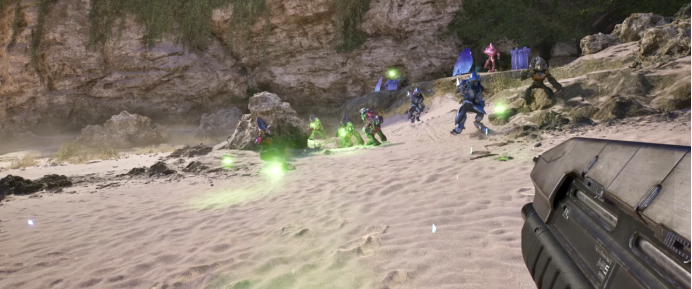
Plasma Pistol
Excellent shield removal.
Often underestimated.
Shotgun
The definitive Flood weapon.
Critical in close quarters.
Plasma Rifle
Strong sustained anti-shield pressure.
Rocket Launcher
High-risk anti-vehicle and crowd control tool.
The Magnum Is Not Strong Because of Damage Alone
Most guides say:
“The pistol is overpowered.”
But the real reason is:
Combat flexibility.
The Magnum combines:
- precision
- range
- shield pressure
- ammo efficiency
This lets players control engagements dynamically.

The opening missions on Installation 04 focus heavily on survival and adapting to hostile environments, much like the atmospheric tension found in exploration-driven titles such as The Free Shepherd, where environmental awareness plays a key role in progression.
Covenant Strategy — How Enemy AI Actually Works
Halo’s Covenant AI was groundbreaking because enemies behave differently based on battlefield conditions.
Examples:
Grunts panic
When leaders die.
Elites retreat or reposition
When shields break.
Jackals pressure range lanes
With shield coverage.
This creates:
emergent combat behavior.
Not scripted encounters.
Flood Strategy
Many new players dominate Covenant fights then collapse against the Flood.
Why? Because the combat philosophy changes completely.
Against Covenant:
- precision matters
Against Flood:
- crowd control matters
That transition is intentional.
Flood Encounters Punish Slow Decision-Making
Most articles simply say:
“Use the shotgun.”
That’s only partially true.
Flood combat tests:
- movement
- positioning
- reaction speed
- target prioritization
Players who hesitate often become overwhelmed instantly.
Vehicle Guide
Halo vehicles succeed because they are: physics-driven sandbox tools.

Not scripted sequences. The Warthog especially became iconic because:
- it feels unstable
- movement is dynamic
- terrain affects handling
- passengers influence combat flow
That creates memorable unscripted moments.
Legendary Difficulty Guide
Legendary is where Halo’s systems fully reveal themselves.
Key rules:
1. Respect Elite accuracy
Never overexpose.
2. Plasma weapons become mandatory
Shield stripping matters enormously.
3. Memorization helps—but adaptability matters more
Enemy behavior remains dynamic.
4. Grenades become survival tools
Not optional damage boosts.
5. Positioning matters more than aggression
Overcommitting gets punished instantly.
Legendary Is About Information Management
Most players think Legendary only increases damage. Actually it changes:encounter pacing.
You must constantly manage:
- sightlines
- shields
- ammo
- enemy priorities
- retreat timing
That’s why Legendary feels so satisfying.
Hidden Mechanics Most Players Miss
Look for:
- Elite shield stagger behavior
- Grunt morale systems
- Enemy flanking logic
- Vehicle physics exploitation
- Grenade chain reactions
- AI line-of-sight manipulation
- Flood pathing weaknesses
- Dynamic combat rebalancing
These mechanics create Halo’s famous sandbox feel.
Best Early Strategy
For new players:
Step 1
Use plasma against shields.
Step 2
Swap to precision weapons immediately after shield breaks.
Step 3
Prioritize Elites.
Step 4
Keep moving constantly.
Step 5
Save shotgun ammo for Flood-heavy areas.
Step 6
Use vehicles aggressively—but carefully.
This creates smoother progression throughout the campaign.

Combat encounters gradually increase in complexity, requiring players to understand systems and positioning—something fans of RPG progression will also recognize from games like Gothic 1 Remake, where learning mechanics is essential for survival.
Why Halo: Combat Evolved Still Matters
Most shooters after Halo copied:
- shield systems
- two-weapon limits
- vehicle integration
- console FPS controls
But Halo’s real innovation was:
encounter-driven sandbox combat.
Every fight becomes a small tactical puzzle.
That design still influences FPS games today.
Final Verdict
Most coverage reduces Halo: Combat Evolved to:
- nostalgia
- old graphics
- “classic shooter”
But that misses why the campaign remains important.
Halo succeeded because it created:
dynamic combat ecosystems where AI, weapons, terrain, and player choices constantly interact.
That design philosophy still feels modern decades later.
And very few FPS campaigns have matched it completely.
FAQ
Is Halo: Combat Evolved still worth playing?
Absolutely. Its campaign design, AI systems, and sandbox combat remain influential even today.
When Does Halo: Campaign Evolved Come Out?
Halo: Campaign Evolved is officially scheduled to release on July 28, 2026, for PlayStation 5, Xbox Series X/S, and PC.
What is the best weapon in Halo CE?
The M6D Magnum is widely considered the strongest all-purpose weapon because of its precision, versatility and damage efficiency
Why is the Flood reveal so famous?
Because it completely changes the tone and structure of the campaign midway through the game.
Is Halo CE difficult?
Normal difficulty is accessible, but Heroic and Legendary can become very challenging due to aggressive enemy AI and resource management.
What is the best strategy against Elites?
Use plasma weapons to remove shields, then finish them with precision ballistic weapons.
Why is the shotgun important?
It becomes extremely effective against Flood enemies due to their aggressive close-range behavior.
#Related Articles
– The Free Shepherd Guide: Everything You Need to Know
– Hell Let Loose Vietnam Guide: Everything You Need to Know
– Gothic 1 Remake Guide: Beginner Tips